Clouds of uncertainty continue to loom over the solar industry. Policy changes, shifting incentives, and new utility rules have changed the game, leaving homeowners asking: is solar still worth it in 2026?
The short answer is yes. Despite all the changes, demand for solar continues to grow. The industry continues to adapt and evolve with new technologies and innovations to keep solar at the forefront.
So yes, spoiler alert: solar is still worth it. But how you go solar matters more than ever.
What Changed?
While much has changed in just the last few years, there are two major changes that have reshaped the solar landscape in California: the transition to NEM 3.0, and the expiration of the federal solar tax credit for homeowners.
Understanding NEM 3.0
California’s shift from NEM 2.0 to NEM 3.0 dramatically changed how solar savings work. Under the older NEM 2.0, homeowners received near retail value for excess electricity that was sent back to the grid. This offered significant financial savings, allowing your solar panels to offset most or even all of your electric bill in some cases.
Under NEM 3.0, export rates are significantly lower. The amount of money you can save by going solar under NEM 3.0 is therefore nowhere near what it was under NEM 2.0, completely changing the calculus and often making people think twice about investing in solar when the financial return is not what it used to be.
The End of the Federal Solar Tax Credit
For years, the federal solar tax credit offered a 30% credit on new solar installations, making systems far more accessible and affordable for homeowners. The Trump administration officially ended the credit at the end of 2025, quickly making going solar significantly more expensive. While there are new and creative ways to still earn these savings, the end of the federal tax credit delivered a significant blow to solar accessibility.
When you combine the decreased savings of NEM 3.0 with the increased costs of going solar without the federal solar tax credit, you get a deal that offers far fewer financial incentives than it used to. Put simply, going solar is no longer the easy win it once was.
However, that doesn’t mean that it is no longer worth it.
Is Solar Still Worth It Financially?
Despite all these changes, yes, solar is still worth it financially. Even if NEM 3.0 and the end of the federal tax credit make it less lucrative, it’s still financially beneficial. While you may not save as much as you might have just five years ago, you’ll still be saving something.
Additionally, utility rates continue to rise, so even under NEM 3.0, generating your own electricity allows you to avoid paying peak utility rates.
But if you’re looking to save more, the strategy for doing so has now changed. Solar-only systems will provide some savings, but the best way to maximize your return on a solar system is to pair it with a battery.
The New Strategy: Solar + Storage
Going solar without a battery is now becoming increasingly difficult to justify in 2026. Doing so at this point is just leaving money on the table. A battery allows you to:
Store excess energy instead of exporting it at low rates
Use stored energy during peak pricing periods
Reduce reliance on the grid when electricity is at its most expensive
Solar-plus-storage isn’t a new concept, but as batteries become more prevalent and solar savings become harder to come by, adding a battery to your system is now more of a necessity than a luxury.
Why System Design & Optimization Matters Now
With fewer incentives and higher upfront costs, it’s more important now than ever to install a system designed to maximize your savings. Details like usage patterns, system sizing, and knowledge of interconnection rules now matter more than ever when trying to get the best financial outcome.
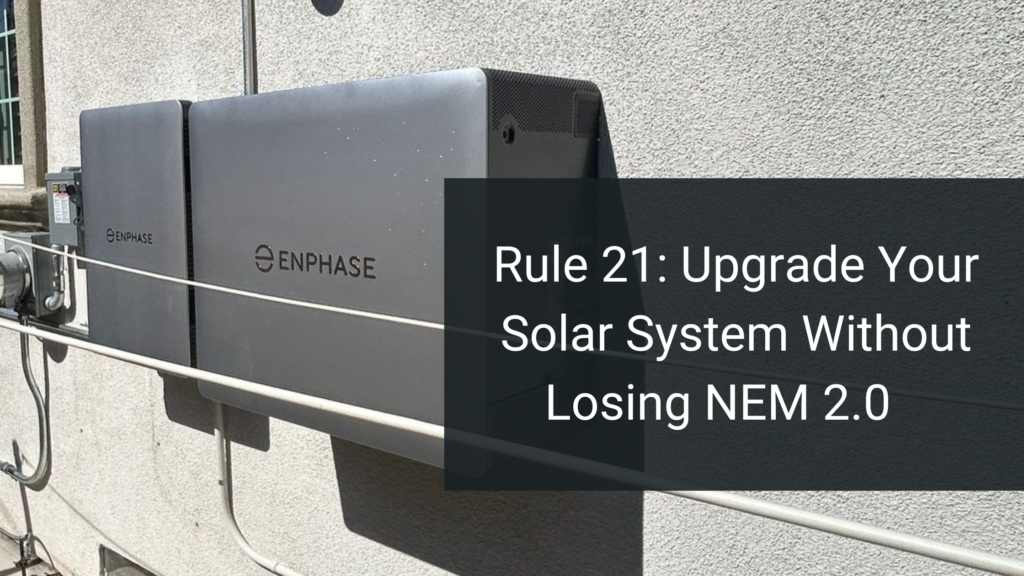
Homeowners still on NEM 2.0 have a significant advantage, as their systems continue to benefit from higher export rates. Adding a battery to an NEM 2.0 system can increase its benefits – but only if the system is configured correctly. Making the wrong modification or expansion could trigger a transition to NEM 3.0, which would fundamentally affect the system’s economics.
This is where understanding California’s Rule 21 becomes crucial. These rules govern how systems can be modified and how they interact with the grid. If you know how to navigate them, you can modify and expand your system without losing your NEM 2.0 benefits.
How you pay for your system also matters. With the federal solar tax credit no longer available, many homeowners are exploring options like lease-to-own agreements. These agreements help reduce upfront costs and make solar more accessible in a world where the federal government no longer incentives homeowners.
So Is Solar Still Worth It?
We already said it at the beginning of the article, but we’ll say it again: yes, going solar, despite all the changes, is still worth it in California in 2026. While the old model relied on generous incentives and high export values, the newer model relies on smart system design, energy storage, and a clear understanding of how the rules have changed. It isn’t as simple as it once was, but with a little bit of effort and creativity, you can still reap the benefits of clean solar energy.
Go Solar with Solar Discovery
Solar Discovery offers all-in-one energy solutions, offering solar, battery, and roofing services, to help homeowners take control of their power. With all of the new changes, we’ll make sure to guide you every step of the way to ensure you’re getting an optimal system for your needs. Whether you’re installing a new solar panel system, adding battery storage, or designing a complete clean energy strategy, we’ve got you covered.